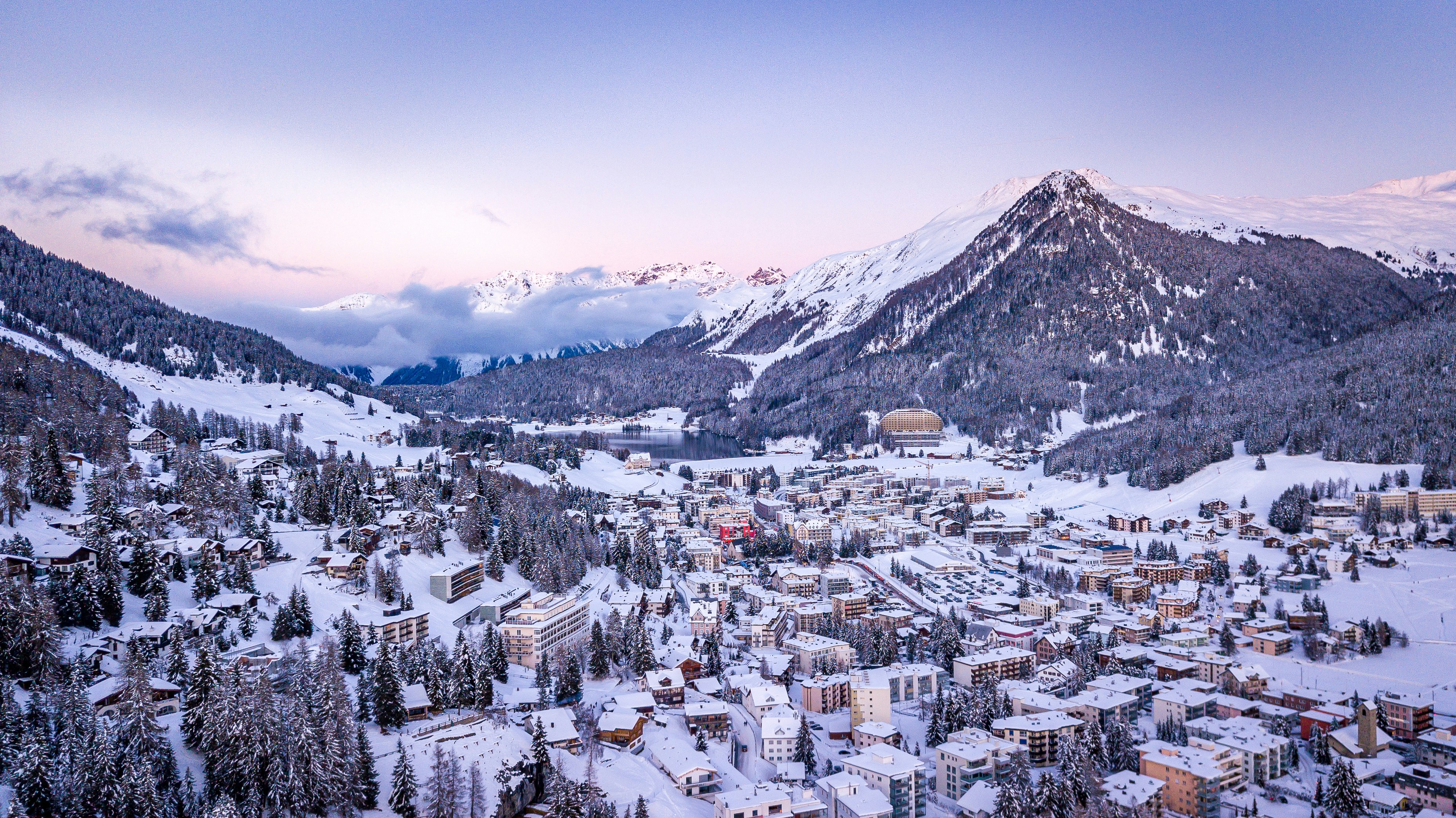
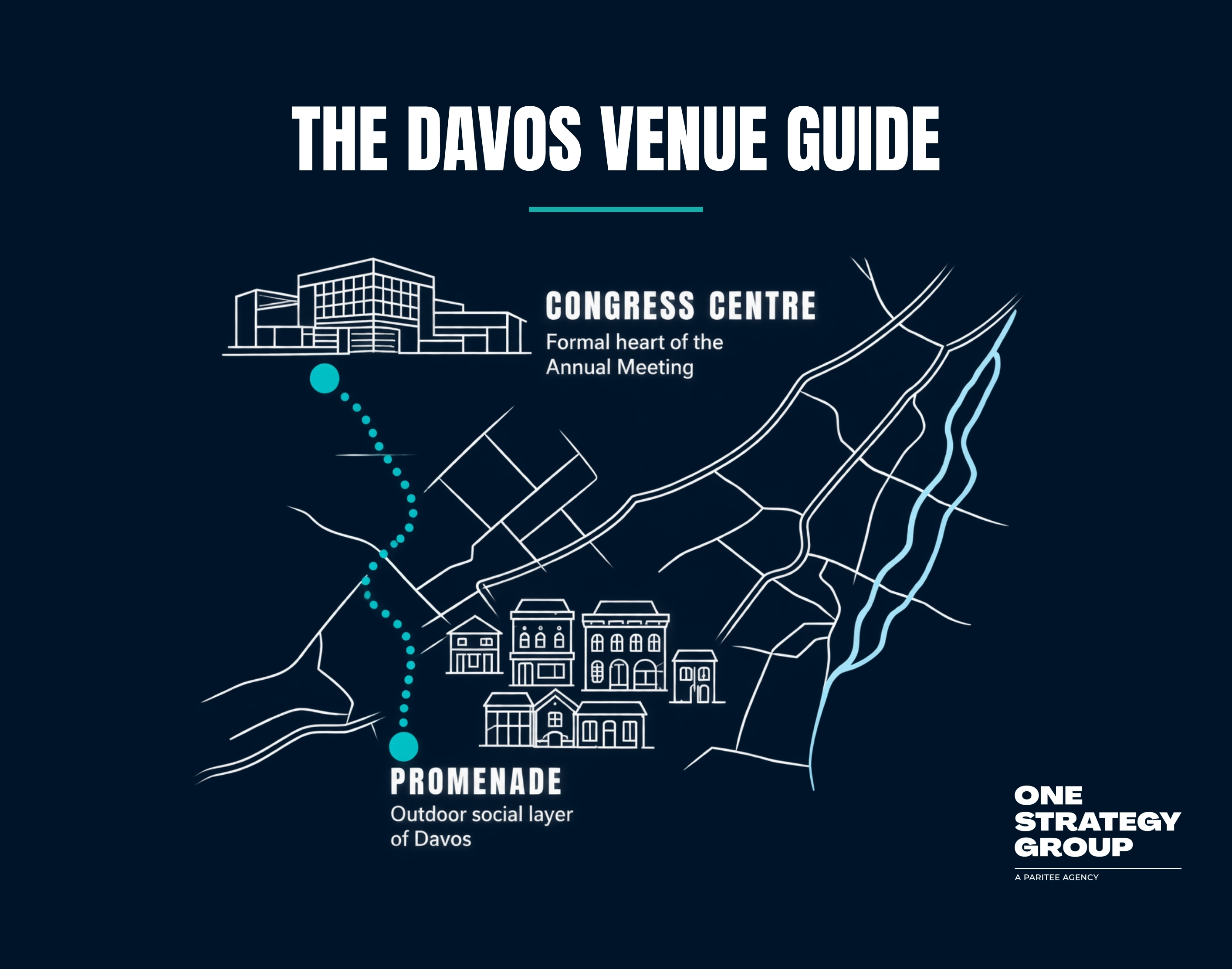
Davos operates as two parallel venues. The Congress Centre is the formal heart of the Annual Meeting — official sessions, lounges, bilateral meeting areas, and the highest density of white badge holders in town. The Promenade is the commercial street running the length of Davos, lined with hotels and storefronts converted into branded "houses" for the week, and it is where the unplanned encounters happen. Get the full map and lay of the land in our Davos 101 Guide.
The Congress Centre is where the official Annual Meeting takes place: panels, workshops, roundtables and bilateral meetings, roughly 3,000 people, all badged.
What first-timers underestimate is how public it is. The Congress Centre is saturated with journalists, competitors and casual observers, and most meeting spaces are in the open.
The practical rule: assume you can be overheard. Do not discuss anything unannounced in the Congress Centre. Some people have learned this the hard way.
Private meeting rooms exist, along with lounges reserved for the highest WEF partnership levels and public figures, but access to those is highly limited. Important work happens in these rooms and if you can access them you should, but most first-timers won’t make it in.
What the Congress Centre is genuinely good for is density and serendipity. The central lounge in particular is where run-ins happen — which is why protecting unscheduled time matters more here than anywhere else in town.
The Promenade is the main commercial street and the outdoor social layer of Davos. Countries, companies and media outlets rent storefronts for the week and run programming out of them, ranging from invitation-only dinners to walk-in cocktail receptions.
Quality varies enormously. Some houses host the most substantive off-programme conversations of the week. Others are brand activations with little intellectual or relational value. There is no reliable way to tell from the outside, which is why the operating instruction is: approach with calibrated expectations, and be ready to leave within ten minutes if the room isn't worth your time.
The Promenade is also where walking pays off. The conversation that starts at a crosswalk, the person you spot going the same direction — these happen on foot, not in a car.
The Congress Centre is the beating heart of Davos, but don’t underestimate the value of events and meetings in the secure hotels.
Bilateral meetings, panel discussions, cocktail hours and private dinners are hosted in the Belvedere, the AlpenGold, the Seehof, the Ameron, the Hilton Garden Inn,the Morosani properties, and select others. Many sit behind a security cordon, and a hotel badge is the minimum credential required to get in. (Our badge guide covers what each credential opens.)
As you are building your schedule, keep in mind that hotel-to-hotel transitions are the expensive part of the day — not because of distance, but because of security queues.
Security timing. Allow 5–10 minutes for Congress Centre security during normal hours. At lunch and in the evenings, particularly at the AlpenGold and the Belvedere, budget 30–45 minutes. A schedule with 15 minutes between events in two different hotels is a schedule that fails at around 2pm on Tuesday.
The line of death. Between the end of the afternoon sessions and the start of evening events, the Promenade becomes a near-impassable queue of security motorcades and private cars. If you are in a vehicle during this window, you are not going anywhere fast. Never take a car during this transition period unless there is genuinely no alternative.The exceptions are crossing the river and travelling end-to-end across town — for which the local train is reliable and on schedule in a way that buses and cars are not.
More broadly: walking should be your default mode of transport in Davos. The town is small, the main roads are frequently closed by motorcades with no notice, and the traffic around the security cordon is significant. Spontaneous introductions are the currency of Davos and they happen on foot, not sitting in a private car.
If your meeting priorities require guaranteed privacy, private meeting rooms are available through third-party providers at roughly 1,000 CHF per hour and up. Most of these rooms must be booked well ahead of time. Don’t show up expecting that you can find a private place to meet without advance planning.
For most first-timers it is not necessary. The Congress Centre Central Lounge, a corner of the Kongress Hotel lobby, or a walk along the Promenade will handle the great majority of conversations.
What is the difference between the Congress Centre and the Promenade at Davos? The Congress Centre hosts the official WEF Annual Meeting — sessions, lounges and bilaterals, all badged. The Promenade is the public commercial street, lined with branded "houses" running unofficial programming. The Congress Centre is the formal programme; the Promenade is the social layer around it.
Which Davos hotels require a security badge? The main secure hotels include the Belvedere, the AlpenGold (formerly the InterContinental), the Seehof, the Hilton Garden Inn, and the Kongress Hotel. A hotel badge is the minimum credential for most; the Kongress Hotel requires Congress Centre access.
Where do most Davos meetings actually take place? While the Congress Centre remains the center of the action, a large share of work also happens in the secure hotels — bilateral meetings, private dinners and cocktail receptions hosted by companies and delegations.
How long does Davos security take? Five to ten minutes at the Congress Centre in normal hours; 30 to 45 minutes at the busy hotels during lunch and evening peaks.
The full venue guide, the annotated town map, and the badge access hierarchy are in our Davos 101 Guide. Download it free.




