
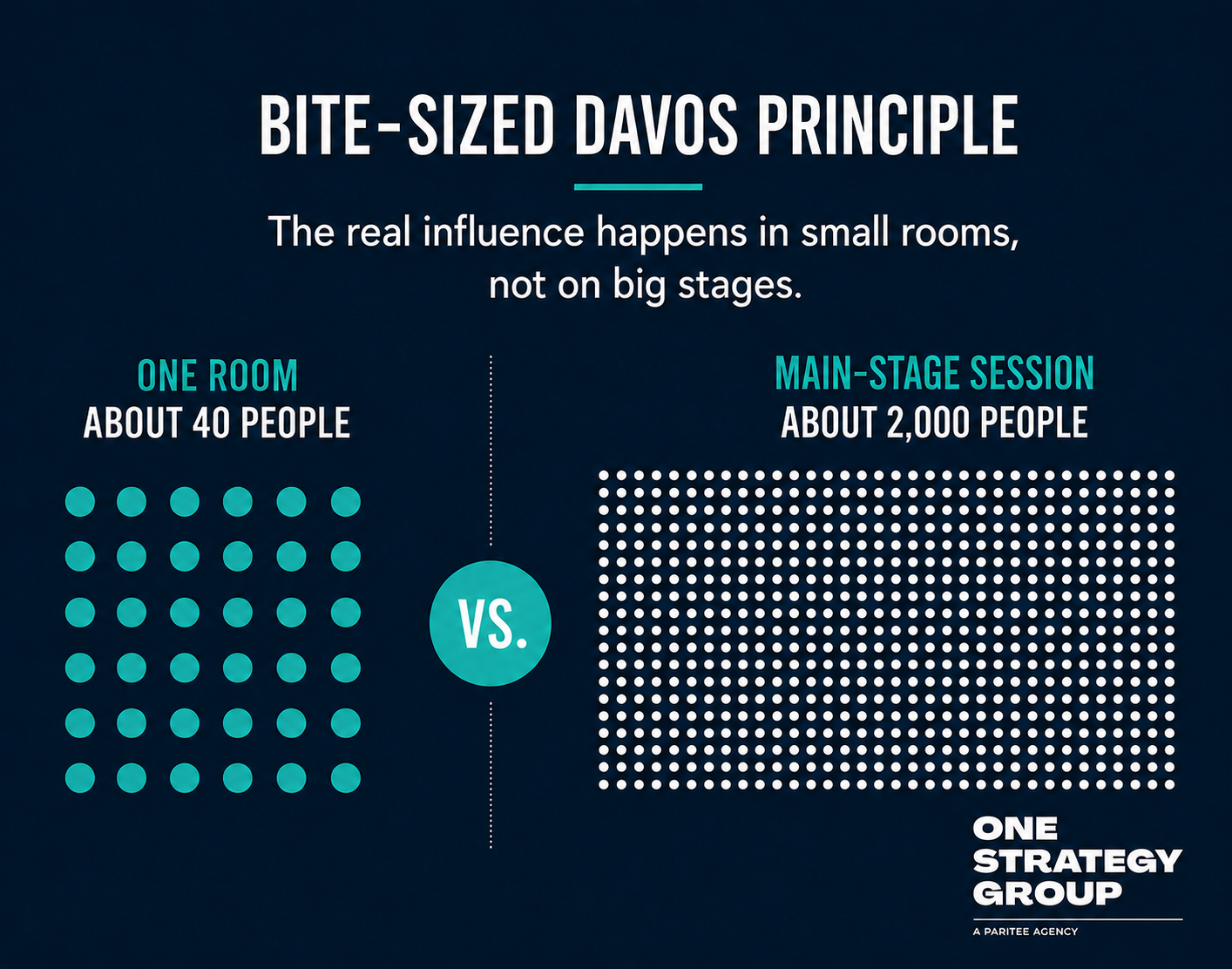
It’s counter-intuitive, but most effective way to network at Davos is to deliberately avoid the biggest rooms and marquee names. A main-stage session where a head of state addresses 2,000 people produces almost no relationships; a 40-person roundtable where the one person who matters to your business is speaking gives you direct access to them the moment it ends. Most Davos meetings run 15 to 30 minutes and are not meant to close anything — the goal is enough genuine mutual interest that a substantive conversation after Davos becomes the obvious next step.
We call this the Bite-Sized Davos principle: take a massive, overwhelming event and break it into a series of small, targeted interactions where you have a real advantage.
There is a gravitational pull at Davos toward the biggest stages and the most prominent names. It is almost always pulling you in the wrong direction.
The metric that matters is the ratio of meaningful interactions to time invested, and the main-stage session performs terribly against it. You will not meet the speaker — they leave through the green room. You will not meaningfully meet the audience — there are two thousand of them and no structure for interaction. You will have watched something that is livestreamed and have no new relationships to show for it.
Main-stage sessions are valuable for context and atmosphere, and you may make the calculation that this is a legitimate reason to attend one or two. They are not, generally, valuable for relationship-building.
The small session is the opposite. In a 40-person roundtable you have genuine post-session access to every panellist and to a self-selected room of people who care about the same narrow thing you do. You can walk up. You can introduce yourself. The conversation has an obvious opening.
Smaller WEF sessions, invite-only roundtables, and Community and Centre gatherings are where the real connections happen. If you are a member of a WEF Community or Centre, prioritise those gatherings during the Annual Meeting — they are consistently among the most valuable conversations of the week.
Before you build any schedule, write down who you are trying to meet. Not "senior people in fintech" — actual names, titles and companies.
Potential investors. Specific partners. Clients you have been trying to reach. Regulators whose perspective matters to your business. Peers whose relationship would unlock something.
Then, for each one, work out the lowest-friction, highest-value way to encounter them. Are they speaking on a panel? Are they likely to be in a specific lounge or at a specific event? Do you have a mutual contact who could make a warm introduction?
The more specifically you have thought this through in advance, the better positioned you are when the moment arrives — and at Davos, the moment tends to arrive without warning.
Some of the best first meetings at Davos do not happen in scheduled bilaterals. They happen in the hallway after a session, in the Congress Centre lounge, or on the Promenade.
But this does not happen purely by chance.
Find out where your target is speaking or appearing. Attend. Position yourself for the post-session moment. Introduce yourself while the conversation is still warm from what was just said — it gives you immediate, relevant context and removes the awkwardness of a cold approach.
The smaller the session, the better this works. In a 40-person roundtable, you will get real access to every panellist. In a 2,000-person main-stage event, they will be gone before the applause finishes.
Calibrate your expectations before you arrive:
Meetings are short by design, and they are frequently interrupted. This is not rudeness; it is the physics of the week.
The goal of a first meeting is not to close anything. It is to establish enough genuine mutual interest that a second, more substantive conversation after Davos becomes the obvious next step. Trying to close in a 20-minute meeting in January is the fastest way to ensure crickets in February.
It is entirely acceptable to approach someone on the Promenade, in the Congress Centre lounge, or at any unofficial event and introduce yourself. This is one of the distinctive cultural norms of the Annual Meeting, and one of its most valuable features: the social permission to introduce yourself is higher at Davos than at almost any other professional gathering in the world.
Everyone is there to make connections.
The approach matters, though. A relevant, human introduction — "I heard you speak on X, and given what we're working on, I wanted to say hello" — goes somewhere. A cold pitch does not. The distinction between connecting and selling is felt immediately, and crossing it damages the relationship rather than creating it.
No handouts, no folders, no pitch decks. Be curious about them before you talk about yourself.
Build empty space into your calendar deliberately and defend it. Plan to spend time lingering in the Congress Centre or walking the Promenade with nowhere to be. This is not downtime. It is when the things you could not have planned actually happen — and at Davos, those are disproportionately the things that matter.
Be present, be available, be engaged. Put your phone away and keep your eyes up.
The discipline is what we call structured whimsy: a deliberate plan with deliberate openings for spontaneity, backed by enough preparation that when the unplanned encounter happens, you are ready for it.
The week is the beginning, not the end. Send follow-up notes within 24 to 48 hours of meeting someone. The window during which Davos is still emotionally and cognitively present for both parties is short. Inside that window, a specific, personal note lands as a natural continuation of the conversation. Three weeks later it lands as a cold email.
Then sort every contact into one of three tiers: immediate action (a live opportunity — move within days), near-term nurture (worth a follow-up meeting in three to six months), and long-term relationship (no near-term opportunity, but worth maintaining).
This is also where the ROI case gets made. Track which outreach produced meetings, which meetings produced follow-up conversations, and which conversations produced long term relationships. That pipeline is what you show a board — not a contract signed in January, which almost never happens.
How long are meetings at Davos? Most run 20 to 30 minutes, often 15, and they are frequently interrupted. Schedules shift constantly, so be understanding, remain agile, and be willing to get creative in order to get a meeting back on the schedule.
Is it acceptable to introduce yourself to strangers at Davos? Yes. The social permission to introduce yourself is unusually high — most attendees are there specifically to make connections. A relevant, contextual introduction works; a cold pitch does not.
What is the best way to get meetings at Davos? Start when the preliminary attendee list publishes in November. Email outreach outperforms TopLink. Be specific about why you want to meet, and orchestrate run-ins around sessions your targets are speaking at.
Should you go to the big Davos sessions? One or two, for context. If it’s your first time with a white badge, it’ll be memorable and worth attending one. For relationship-building, small sessions and invite-only roundtables produce far better returns on your time.
Getting into the right rooms is a separate problem. Get the Insider’s Guide to the World Economic Forum. The full chapter on meetings, targeting, and follow-up is in Davos 101. Download it free.




